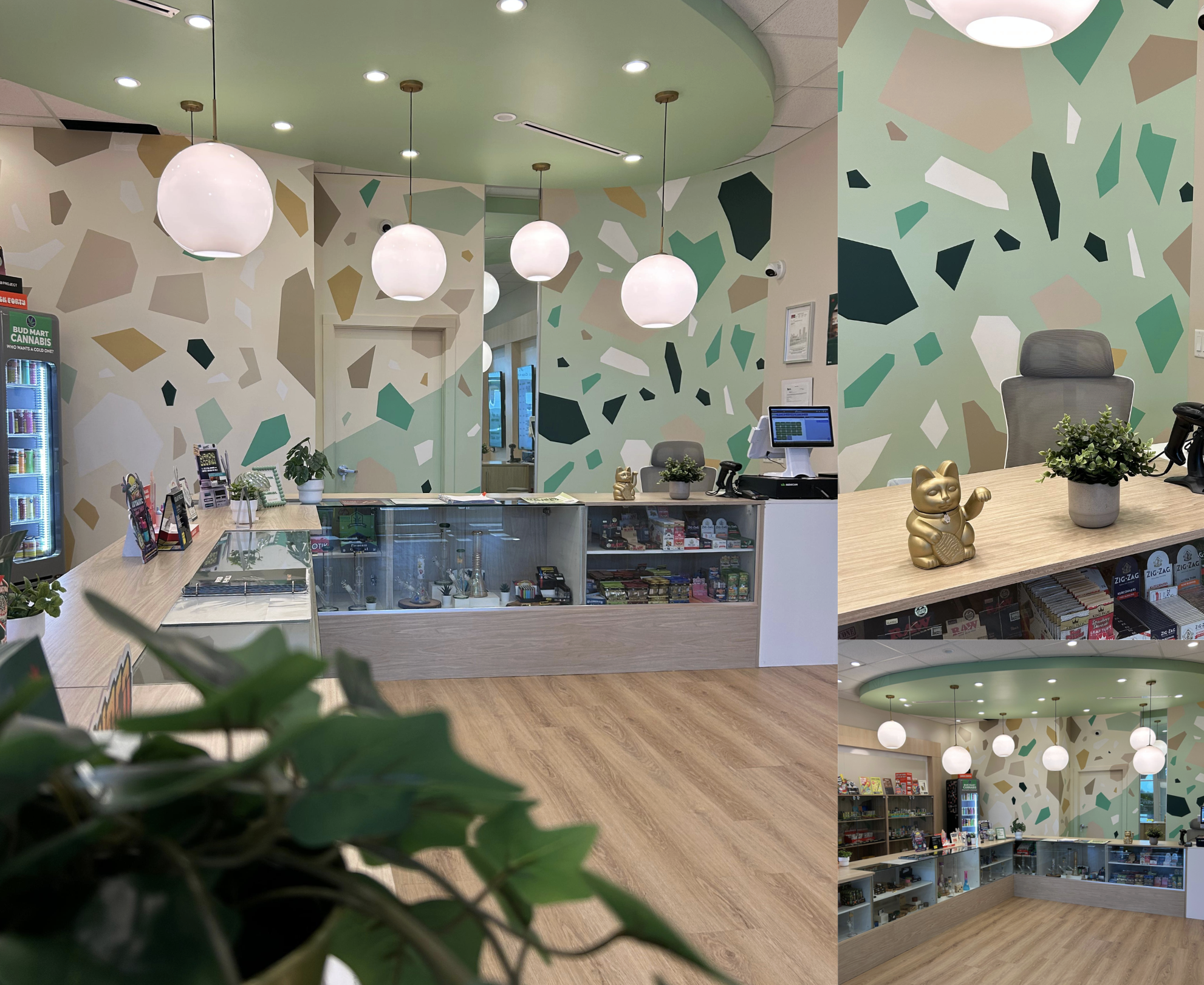
Mosaic Earth: Where Interior Design Meets the Natural World
There is a material called terrazzo that has been used in architecture for over five hundred years. Marble chips set into cement, ground smooth, polished until the fragments become a surface. It is, in essence, broken things made whole again, disparate materials unified through craft into something more beautiful than any of its components. Mosaic Earth borrows this philosophy and translates it from floor to wall, from material to paint, from architecture to art. The result is a large-scale interior mural that transforms a Calgary retail space into something that feels less like a shop and more like stepping inside a geological specimen.
The mural wraps the entire interior perimeter of the space. Against a soft sage green ground, organic geometric shapes in emerald, forest green, cream, warm gold, and deep teal float in a scattered composition that reads as both random and perfectly considered. The shapes are irregular but not chaotic. They reference the fractured forms found in terrazzo, in cross-sections of agate, in the way leaves overlap when viewed from directly below a canopy. The scale varies from small flecks to large, assertive forms that command individual attention while contributing to the overall pattern.
The Palette
KINN Studios built the colour story for Mosaic Earth around the greens that dominate the natural world but are conspicuously absent from most commercial interiors. The sage base provides a neutral warmth that never tips into coldness, a green that reads as welcoming rather than clinical. Against it, the darker emerald and forest tones provide depth, while the cream and gold fragments introduce light and a sense of warmth that prevents the greens from becoming monotonous. The overall effect is remarkably calming. Customers entering the space report an immediate sense of ease, an almost subconscious relaxation that comes from being surrounded by the colours the human eye evolved to find restful.
We painted the walls with the same logic the earth uses to build a riverbed: fragment, scatter, compose.
The photographs of the finished space reveal how thoroughly the mural integrates with the architecture and fixtures of the retail environment. Globe pendant lights hang against the painted walls, their warm glow picking up the gold and cream tones in the pattern. The curved ceiling detail above the service counter creates a natural focal point that the mural's composition responds to, the fragments seeming to radiate outward from the architectural curve. Display cases, wooden countertops, and live greenery complete the spatial composition, each element reading as a natural extension of the mural rather than an interruption of it.
Art as Environment
What distinguishes Mosaic Earth from conventional interior mural work is its ambition to be environmental rather than decorative. The mural does not occupy a feature wall. It is the interior. It defines the character of the space so completely that removing it would not reveal a room behind it but rather destroy the room entirely. This is the territory where art installation and interior design converge, where the distinction between the two disciplines dissolves into something more holistic and more interesting than either one alone.
For KINN Studios, Mosaic Earth represents a particular category of work: projects where the client needs not a painting on a wall, but a transformation of what a wall is. The space was ordinary before the mural. It had the same proportions, the same fixtures, the same light. But paint, applied with intention and spatial intelligence, changed the fundamental experience of being inside it. The fragments on the wall are not decoration. They are an argument that every interior is a landscape, and every landscape deserves to be composed.