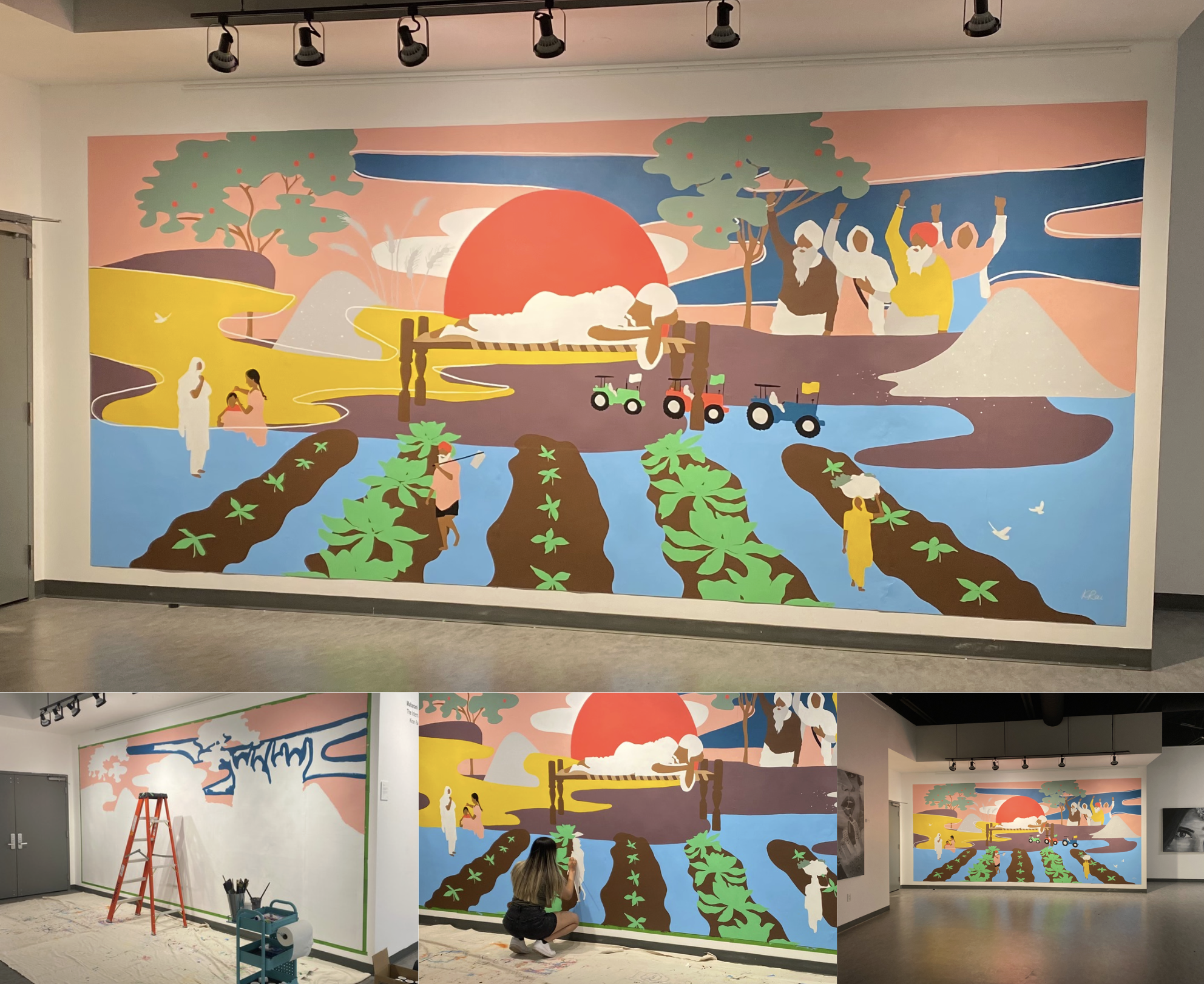
Love for Humanity: An Agrarian Ode to Connection
Before cities, before industry, before the modern apparatus of daily life, there were fields. Rows of green things growing in earth. Hands in soil. A sun that governed everything. Love for Humanity returns to that elemental landscape, not out of nostalgia, but as a way of remembering what compassion looks like when it is practiced at the most fundamental level: people sustaining each other through the work of their hands.
This monumental exterior wall mural spans the full width of its host building, presenting a sweeping panoramic scene drawn from the agrarian traditions of Punjab. A massive red sun sits at the horizon, half-descended or half-risen, its position deliberately ambiguous. Before it, the landscape unfolds in horizontal bands of colour: golden wheat fields, blue waterways, rows of deep brown earth planted with green crops, and figures scattered throughout, each engaged in the quiet rituals of agricultural life.
The Landscape
KINN Studios composed this mural as a true landscape painting at architectural scale. The eye enters from the left, where a seated figure in white watches over the scene with the stillness of a guardian or elder. The gaze moves across fields where workers tend crops, past tractors that bridge tradition and modernity, toward a group of figures on the right who stand together with raised arms, their posture reading as both celebration and welcome. Birds take flight from the middle ground. Trees with spreading canopies anchor the upper register. The entire composition breathes with the unhurried rhythm of agricultural time.
The oldest form of love is the act of feeding someone. Everything else is commentary.
The palette is extraordinary in its warmth. Peach and salmon skies grade into soft blues. Yellows range from gold to ochre. The greens of the crops are saturated and alive, almost luminous against the brown earth. This is not a muted, dusty depiction of rural life. It is radiant, generous with colour in a way that mirrors the generosity of its subject matter. The visual language draws equally from South Asian miniature painting traditions, mid-century illustration, and the flat, graphic style that defines the KINN Studios approach to large-scale work.
Scale and Process
The process images included in the documentation reveal the physical enormity of the undertaking. The artist works from a ladder, the initial sketch visible on the raw wall in loose blue outlines that will eventually become the detailed, layered composition seen in the finished piece. The gallery-like interior setting suggests this mural occupies a significant institutional or cultural space, its white walls and track lighting treating the work with the seriousness of a fine art installation while maintaining its accessibility as a public artwork.
Love for Humanity is, in the end, a painting about sustenance in all its forms. The sustenance of food grown from the earth. The sustenance of community formed through shared labour. The sustenance of cultural memory carried across oceans and generations and planted in new soil. It is a work that asks nothing of its viewer except a moment of recognition: that the most enduring human connections are not built on grand gestures, but on the daily, repeated act of caring for what grows.