Public art calls in Alberta are open, well run and, for most artists, unfamiliar. The documents are long, the scoring is invisible and the difference between a Request for Qualifications and a Request for Proposals is not explained anywhere in the call itself. Having submitted to calls as an artist and worked on commissioned public pieces including Vibrance in Diversity for Ward 5 and SAWA with CADA and artist Maya Corona, we wrote down what we wish someone had told us at the start. This is the practical version: where calls appear, what each type asks for, and how to assemble a submission a panel can score.
Where Alberta Calls Are Posted
Each city runs its own program, and each posts its calls on its own site.
- Calgary. Calgary Arts Development administers the City of Calgary's public art program and posts open calls, artist rosters and opportunities on its website. Community and BIA-funded projects are separate and usually posted by the organisation directly; our community mural funding guide lists those routes.
- Edmonton. The Edmonton Arts Council manages Edmonton's public art collection and program under the city's percent-for-art policy, and posts calls on its website.
- St. Albert. The City of St. Albert runs a public art program and posts calls through the city's website and its arts channels.
- Lethbridge. The City of Lethbridge runs a public art program and posts its calls on the city's website.
- Province-wide. The Alberta Foundation for the Arts and CARFAC Alberta circulate calls from across the province, including from smaller municipalities, developers and institutions.
Sign up for each mailing list. Calls have fixed deadlines and there is no late submission. Many programs also maintain a pre-qualified roster; getting onto a roster is itself an RFQ and is worth doing in a quiet year.
RFQ or RFP: Read Which One It Is
A Request for Qualifications asks who you are. It wants a portfolio of past work, a CV, a short statement of interest that explains why this site and this brief suit you, and sometimes references. It does not want a design, and submitting one is a common mistake. Panels at RFQ stage are asked to assess capability and fit, and a rendered concept tells them you have not read the call.
A Request for Proposals asks for the idea. It usually follows an RFQ shortlist and often comes with a fee for the shortlisted artists to develop a concept. It wants drawings or renderings, a written description, a materials and fabrication approach, a maintenance note, a schedule and a budget. Some smaller calls are a single-stage RFP, in which case you are designing at risk; decide early whether the commission value justifies that.
Read the scoring criteria if they are published. They tell you what the panel is instructed to weigh, artistic merit, relevance to site and community, technical feasibility, experience, and you should structure your submission in that order with those words as headings.
The Portfolio
Calls limit portfolio images, typically to between eight and fifteen, and they mean it. Choose work that is relevant to the call's scale and setting rather than your best-known pieces. If the call is for an exterior sculptural work and you have only painted murals, include the murals that were exterior, large and durable and say so in the captions. Every image needs a caption with title, year, location, commissioning body, dimensions, materials and budget where you are allowed to share it. Panels read captions; an uncaptioned image scores as if it were absent.
Where a project was collaborative, credit it correctly. Panels in Alberta are small and people know each other's work. Our post on portfolio essentials is written for commercial clients but the principles hold: clear images, honest captions, evidence of finish at scale.
The Artist Statement and Statement of Interest
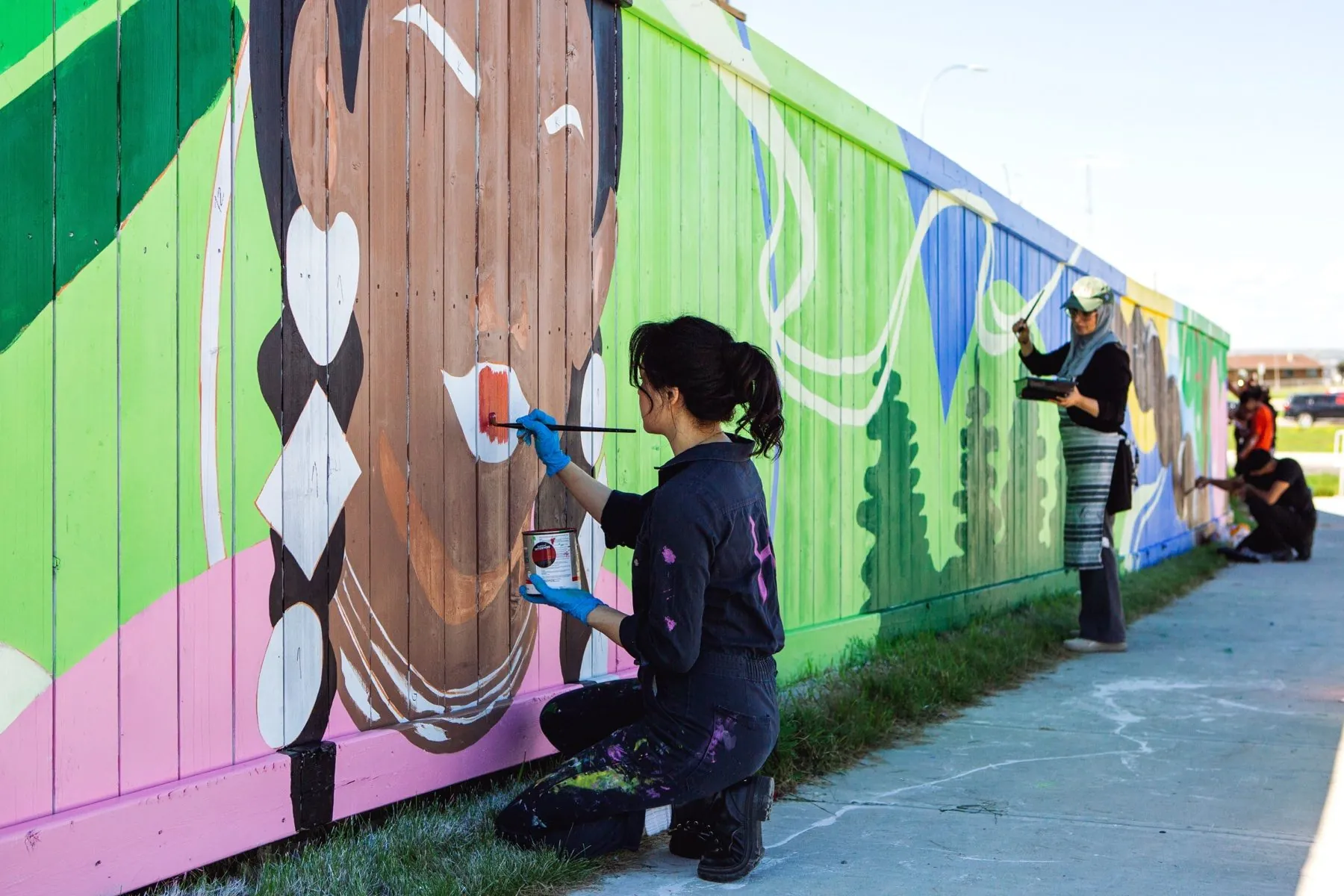
These are different documents. The artist statement describes your practice in general: what you make, why, and how. Keep it to a page and write it plainly. The statement of interest is specific to the call: why this site, this community, this brief. It should show that you have read the call, looked at the site (in person if you can) and thought about who uses it. If the call names a community, say how you would engage with it, concretely: workshops, surveys, painting days, consultation with a named organisation. Vibrance in Diversity was developed through surveys, pop-up engagement and a school workshop, and that process was part of what the commission asked for.
Do not restate the call's own language back to it. Panels have read the call. Tell them something they do not know about how you would approach it. If the call concerns Indigenous themes, land or history, read our post on Indigenous public art in Calgary and consider whether the project needs a collaboration rather than a solo response.
An RFQ asks who you are. An RFP asks what you would make. Answer the question that was asked.
Building a Public Art Budget
At proposal stage the budget is scored for realism, not for being low. A public art budget in Alberta normally has to cover all of the following, and the panel will check.
| Budget Line | Typical Share of Commission |
|---|---|
| Artist fee (design, engagement, project management) | 15 - 25% |
| Engineering and permits | 5 - 10% |
| Fabrication and materials | 35 - 50% |
| Site preparation, footings, installation, equipment | 10 - 20% |
| Insurance, transport, documentation, signage | 5 - 10% |
| Contingency | 10% |
These shares are typical of what we have seen and quoted, and they vary with the medium; a painted mural has a much larger fee share and a much smaller fabrication one. Whatever the split, GST is usually on top of the commission value unless the call says otherwise, and the artist fee is where most first submissions are too low. Price your time properly. For painted work our Calgary mural cost guide gives the per-square-foot bands a panel would recognise.
Engineering, Maintenance and Durability
Anything freestanding, suspended, climbable or fixed to a structure will need stamped drawings from an engineer licensed to practise in Alberta before fabrication. At proposal stage you do not need the stamp, but you do need to have spoken to an engineer or fabricator and to say so. A single sentence, "we have discussed the footing and wind load approach with a structural engineer and allowed for it in the budget", moves a submission from hopeful to credible.
Maintenance is scored more heavily than most artists expect, because the commissioning body will own the piece for decades. Say what the materials are, how they age, how graffiti would be removed, what needs doing annually and what the expected life is. For painted work in Alberta's climate, name the paint system; our post on how long a mural lasts in Calgary explains why silicate and acrylic systems age differently. For built work, name the finish and the fixings. This is where architectural training is useful, and it is part of what we bring to the artists we work with through our artist collaborations.
Before You Submit
- Check the file formats, image sizes and page limits, and follow them exactly. Submissions that break the format are often removed before scoring.
- Put your name and the call title on every page.
- Have someone outside your practice read the statement of interest and tell you what it says. If they cannot summarise it in a sentence, rewrite it.
- Submit a day early. Portals slow down at the deadline.
- If you are not shortlisted, ask for feedback. Most Alberta programs will give it, and it is the fastest way to improve the next submission.
For context on what commissioning bodies are looking for this year, see our post on 2026 public art trends in Calgary, and for a walk past finished commissions, the East Village public art tour.
Frequently Asked Questions
What is the difference between an RFQ and an RFP in public art?
A Request for Qualifications (RFQ) asks who you are: a portfolio, a CV, a statement of interest and sometimes references. You are not asked to design anything. A Request for Proposals (RFP) asks for a concept, usually with drawings, a budget and a schedule, and is often a second stage after an RFQ shortlist. Never submit a design to an RFQ; it wastes your time and can count against you.
Where are public art calls posted in Alberta?
Calgary Arts Development posts calls for the City of Calgary's public art program. The Edmonton Arts Council posts calls for Edmonton's program. The City of St. Albert and the City of Lethbridge run their own public art programs and post to their websites. Many calls also appear on the Alberta Foundation for the Arts and CARFAC Alberta channels, and larger ones on national procurement sites.
Do I need an engineer to respond to a public art call?
Not at the qualification stage. At the proposal stage you should have spoken to one, and for any freestanding, suspended or climbable piece the commissioning body will expect stamped drawings from an engineer licensed in Alberta before fabrication. Include a line for engineering in your proposal budget and name the engineer or fabricator you intend to work with if you can.
If you are an artist preparing a submission and want help with the spatial, engineering or budget side, or a commissioning body writing a call, get in touch. We have sat on both sides of the table and are happy to talk it through.