Shopping centre marketing teams in Calgary, at CF Chinook Centre, Southcentre, CrossIron Mills, Market Mall, Deerfoot City and the community centres around them, are asked to do something difficult: give people a reason to stay in a building they came to for one errand. Dwell time is the measure, and the honest truth about most activations is that they do not move it. A branded backdrop in centre court is passed in four seconds. This post is about the formats that do move it, and how to design them so they earn the floor space they occupy.
We write this from the design side. KINN has painted in a Calgary shopping centre, with Co-Existence at CrossIron Mills in 2020. What follows is what we have seen work from the floor.
Start With the Three Things That Hold People
Every activation that increases dwell time does at least one of three things. It gives people somewhere to sit. It gives them something to do. It gives them something they want a picture of. The best do all three, and the order matters: seating first, because a place to rest is the only thing that reliably keeps a family in a centre for another twenty minutes.
Seasonal Installations With a Reason to Return
Seasonal work is the backbone of a centre's calendar, and the trap is treating each season as decor to be replaced. A seasonal installation earns more if it changes over its run. A spring installation whose planting grows in. A summer piece with a weekly element, a new colour, a new question on the wall, a new object hidden in it. A Christmas environment with a countdown built into the structure rather than printed on a sign. People come back to see what changed, and each return is a visit that would not otherwise have happened.
Design for the specific court. Ceiling height, skylights, the direction people arrive from and where the nearest seating already is all change what will work. An installation designed for a double-height atrium fails in a low corridor and the reverse. Our post on Christmas and holiday installation ideas for Calgary offices and malls goes into the winter season in detail, and window display design covers the tenant-facing side.
Photo Moments That Are Not Photo Walls
A photo wall is a flat surface with a logo and a hashtag. People know what it is and most of them walk past it. A photo moment is a place that is good to be in, and the picture follows. The difference is depth, scale and light. Something to stand inside, under or between. Something bigger than a person. Lighting designed for faces rather than for the branding.
The practical design rules are simple. Put the moment where people can stop without blocking a corridor. Give the frame something people can interact with rather than just stand in front of, a swing, a doorway, an oversized object. Make sure the image works without any text visible, so that when it is shared, the space itself carries the centre's identity. And light it for evening, when the daylight from the skylights has gone and most of the photography happens. Our post on interactive installations for events covers how to add a participatory element without adding staff.
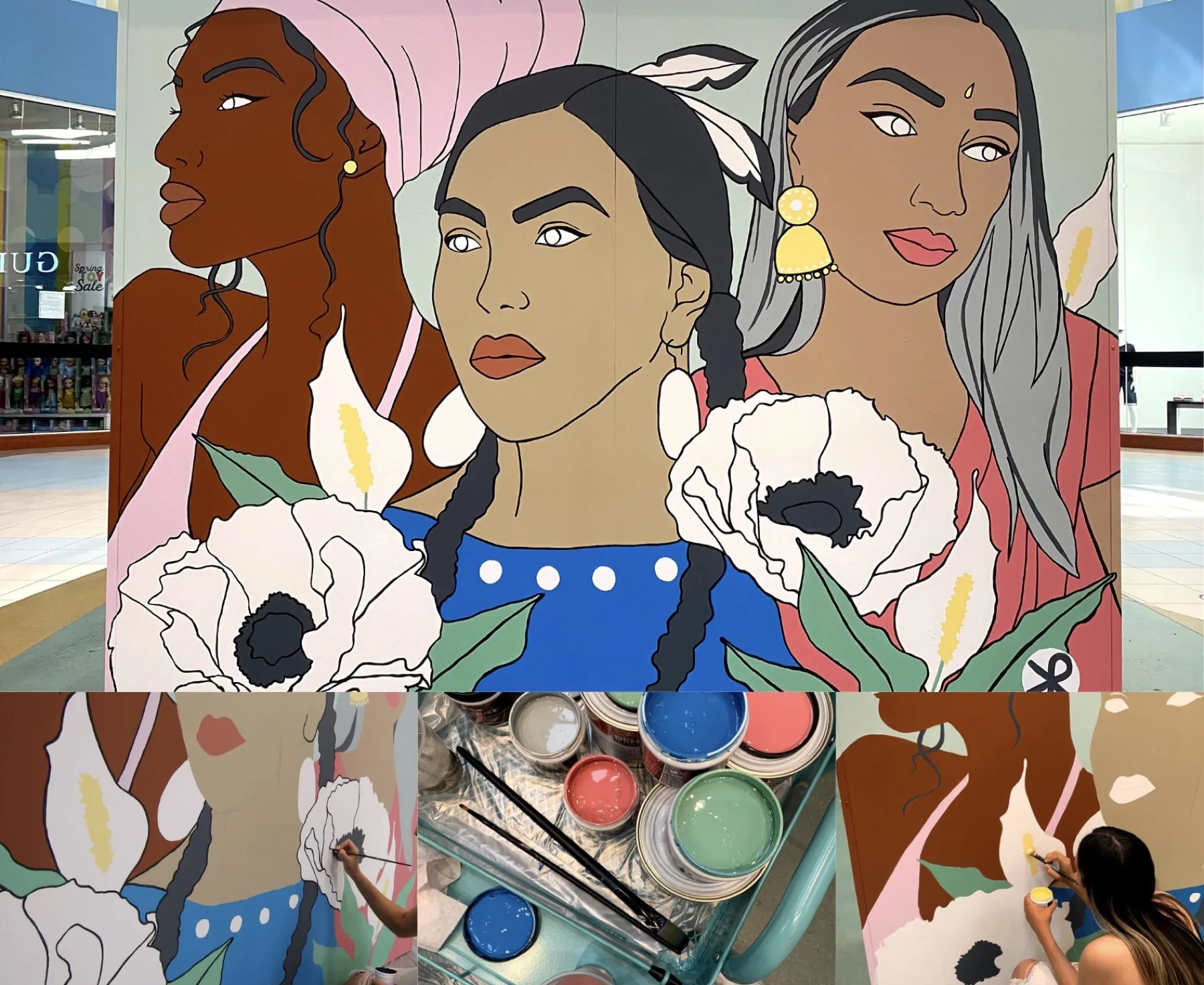
Artist-Led Installations
Centres are increasingly commissioning artists rather than renting themed props, and the reason is simple. An artist-led piece is specific to the centre and the community around it, so it cannot be seen anywhere else, and it gives local press and social channels something to say. Co-Existence at CrossIron Mills was a portrait mural on wood panel celebrating women from different backgrounds; it belonged to that centre and its shoppers in a way a rented installation could not.
Artist-led work also solves a practical problem: it can be made to last. A painted or fabricated piece designed for the centre can stay for a year, move between courts, or be reinstalled the following season, which spreads the cost over more visits than a six-week rental. If you are commissioning at this scale, our guide to hiring a mural artist in Calgary and our art installations page cover the process, and placemaking in Calgary explains why site-specific work builds loyalty to a place.
People stay for a place, not for a backdrop.
Sponsor Integration That People Do Not Mind
Sponsors fund most centre activations, and the tension is real: the sponsor wants visibility, the centre wants an experience, and shoppers want neither to feel like an advertisement. The resolution is to design the sponsor in rather than on. A car brand's activation becomes a lounge built from the car's interior materials. A beverage sponsor's installation is the colour of the drink and offers somewhere cool to sit with one. A bank sponsors a children's play installation about counting. The product or purpose becomes the material or the activity, and the logo can then be small.
Contractually, agree the sponsor's placement at concept stage, not at install. A logo added to a finished design always looks added. We have found sponsors accept restraint readily when they can see that the activation itself will be photographed and shared more than a logo wall would be. For more on this balance, see our complete guide to brand activations in Calgary.
Pop-Ups and Tenant Collaborations
A vacant unit is a cost until it is an activation. Short-term pop-ups, designed properly rather than furnished from the storeroom, give a centre a new reason to visit and give a tenant or a local brand a low-risk trial. The design brief is the same as for any pop-up: an arrival, a core moment and a reason to share, built to be installed and struck in days. Our post on pop-up retail design in Calgary covers the fit-out side, and pop-up brand activations the launch side.
Tenant collaborations are the least used and often the most effective. A restaurant tenant's mural becomes part of a centre-wide art trail. A beauty tenant's launch becomes a centre court event with the centre's own installation as the backdrop. A tenant's mural is tenant work, but once it is up it is also a piece of the centre, and that is the kind of overlap worth planning for.
Measuring Whether It Worked
Decide the measure before the design starts. Dwell time from the centre's own footfall data is the primary one. Seating occupancy, counted at intervals, is a useful secondary. Content generated, tagged posts and press mentions, is the third. An installation designed for dwell will show up in the first two within its first week. If it does not, the problem is usually location or seating, both of which can be changed mid-run if the piece was designed to move. We can help set that up as part of the experiential design process, so the activation is built to be measured from the start.
Frequently Asked Questions
What makes a mall activation increase dwell time?
Somewhere to sit, something to do and something worth photographing, in that order. Seating that is part of the installation keeps people in the centre longer than a backdrop alone. A short activity, such as making, voting or playing, adds minutes. A designed photo moment extends the visit and carries it online. Activations that offer only a branded surface to look at are walked past.
How far ahead should a shopping centre plan a seasonal activation?
Four to six months for a custom-designed installation, and longer for Christmas, where fabrication shops and installers are fully booked from September. A spring or summer activation should be briefed in the previous autumn. Shorter timelines are possible for painted or modular pieces, but the best work comes from time to design for the specific court.
Can a mall activation be sponsored without looking like an advertisement?
Yes, if the sponsor is built into the idea rather than added to the surface. The sponsor's product, colour or purpose becomes the material or the activity, and the logo is placed with restraint. An installation people enjoy and a sponsor credit they notice afterwards outperforms a logo wall every time.
If you manage marketing for a Calgary shopping centre and want an activation designed for your specific court, corridor or entrance, tell us about the space and the season. We will walk it with you and propose something built for the way your shoppers already move.