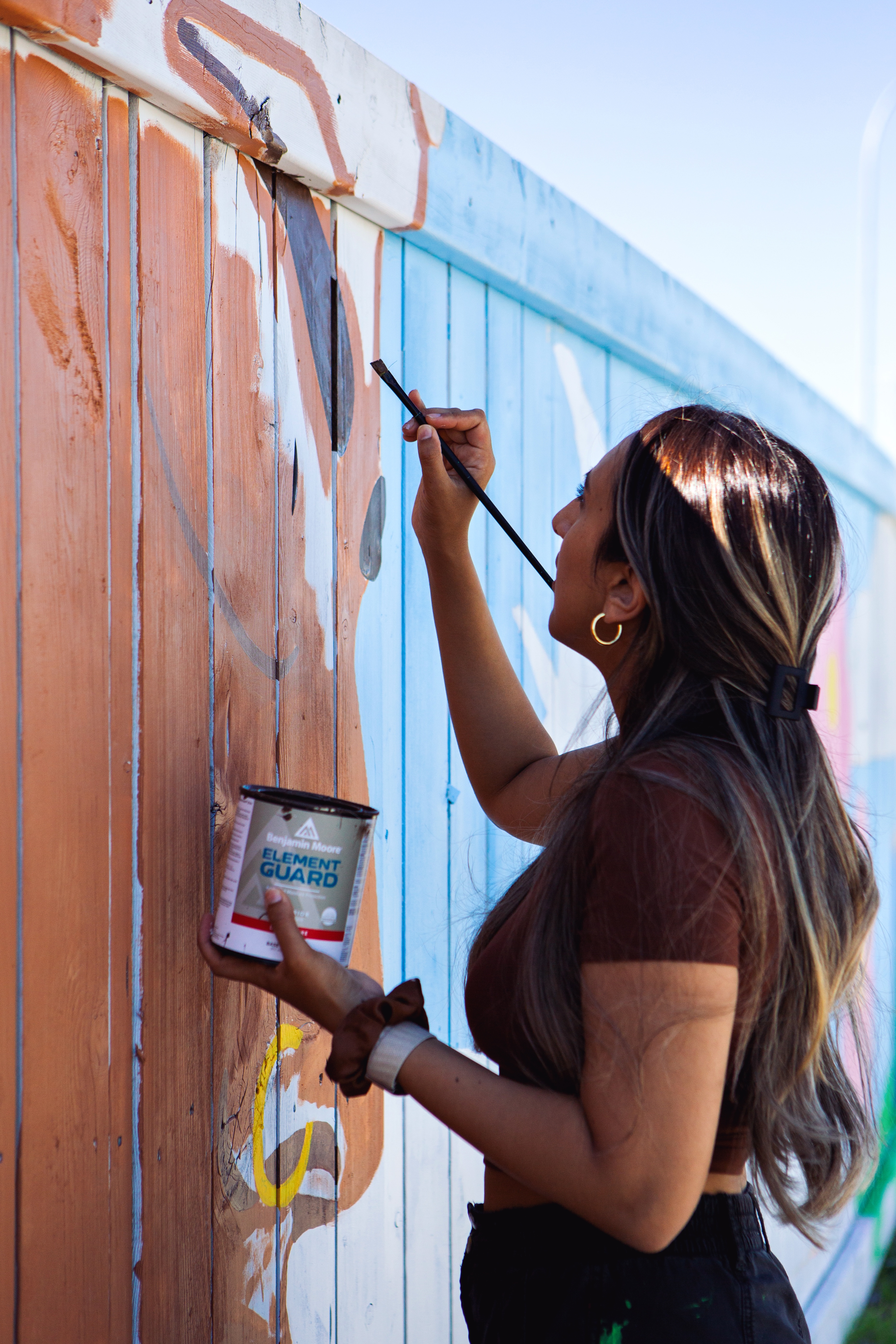
There is a particular kind of knowledge that comes only from sustained observation. You can study a mural's material specifications, understand its protective coatings, read the technical data sheets for every product applied to its surface. But you will not truly know how a mural lives until you have watched it through a full year of Calgary weather, until you have seen it in January frost and July heat, in chinook winds and September rain, in the low amber light of December and the overhead brilliance of June.
This piece is drawn from exactly that kind of watching. Over twelve months, we documented a Calgary exterior mural through every season, photographing it from consistent vantage points, noting changes in colour, texture, and condition, and recording the weather events that tested its resilience. What follows is part photo-essay, part condition report, and part meditation on what it means to make art that must endure the prairie elements.
Summer: The Mural in Its Prime
We begin in summer because that is when an outdoor mural in Calgary is most fully itself. The colours are at their most saturated. The protective coating is at peak integrity. The wall substrate is dry and stable. The light, particularly the long golden hours of a Calgary summer evening, reveals the full chromatic range of the palette.
In June, the mural reads exactly as intended. The warm tones glow in the late-afternoon sun that rakes across the west-facing wall. Shadows from adjacent structures create a moving frame that shifts through the day, isolating different sections of the composition at different hours. Pedestrians pause. Photographs are taken. The mural is performing its public function at full capacity.
By late July, the first signs of summer stress appear. Calgary's UV intensity at altitude is significant, and south- and west-facing surfaces absorb substantial radiation. The clear coat begins to show microscopic chalking, invisible to the casual observer but detectable by running a damp cloth across the surface. Dust accumulation from dry summer conditions dulls the surface slightly. These are normal, expected developments, not damage but the earliest evidence of environmental interaction.
The August hailstorm is the summer's most dramatic test. Calgary sits in one of North America's most active hail corridors, and a significant hail event subjects vertical surfaces to impact forces that no other weather phenomenon matches. After the storm, we inspect for impact damage: small chips or divots in the paint film where hailstones have struck. On well-prepared masonry with a flexible acrylic paint system, the damage is minimal. The paint film flexes rather than shatters. On rigid surfaces, or on murals where insufficient primer was used, hail damage can be more pronounced.
You will not truly know a mural until you have watched it through a Calgary winter
Autumn: The Transition
September in Calgary is the month of reckoning. The temperatures begin to drop. The angle of the sun shifts, casting the mural in a cooler, more oblique light that reveals surface texture with greater clarity. What appeared smooth in July now shows subtle topography: the raised edges of brushstrokes, the slight undulation of the substrate, the hairline patterns where different paint layers meet.
This change in light is not a defect. It is one of the most beautiful aspects of observing a mural through the year. The low autumn sun transforms the surface into something almost sculptural, catching micro-textures that overhead summer light flattens. If the mural was painted with expressive brushwork rather than airbrushed smoothness, autumn is when that craft becomes most visible.
October brings the first frost. This is the moment that the entire material system, substrate, primer, paint, clear coat, is tested in a new way. Water that has infiltrated microscopic cracks during summer rains now freezes, expanding by approximately nine per cent. If the paint system is properly specified and the substrate was adequately sealed before painting, the paint film accommodates this expansion elastically. If not, the freeze-thaw cycle begins its slow work of separation.
By late October, the mural's relationship to its surroundings has changed. Deciduous trees that partially screened the wall in summer have dropped their leaves, exposing the full composition to view for the first time since spring. The mural gains a different audience: people who walk this street daily but had never fully seen the work because of seasonal foliage. It is a reminder that murals exist in a temporal context as much as a spatial one.
Winter: Endurance
A Calgary winter is a stress test for any outdoor material, and a mural is no exception. The challenges are multiple and simultaneous: extreme cold, which makes paint films brittle and reduces their elasticity; snow accumulation against the wall base, which traps moisture at ground level; road salt spray from adjacent traffic, which introduces corrosive chemistry to the surface; and the relentless cycle of freeze and thaw that a chinook city uniquely imposes.
In December, we document the mural under fresh snowfall. The visual effect is striking: the white ground transforms the mural's colour relationships. Hues that appeared warm against summer grass now read as vivid against the monochrome winter landscape. The mural becomes the primary source of colour on its block, a focal point in a world reduced to white, grey, and the dark verticals of bare trees.
January brings the deepest cold. At minus thirty, the paint film is at its most vulnerable to mechanical damage. Any impact, from a wayward snowball to a piece of wind-driven debris, is more likely to chip or crack the surface than it would in summer. The protective clear coat, which in warm weather is flexible and self-healing at a microscopic level, becomes rigid and glass-like. We avoid any contact with the surface during these extreme cold events.
The chinook cycle is Calgary's distinctive contribution to mural stress. In January and February, chinook winds can raise temperatures from minus twenty to plus ten in a matter of hours. This rapid thermal cycling, sometimes occurring multiple times per week, subjects the paint film to repeated expansion and contraction that exceeds what most temperate-climate murals ever experience. It is the single most challenging condition that Calgary outdoor murals face, and the primary reason that material selection and surface preparation for Calgary murals must exceed standard specifications.
Spring: Revelation
March is when we learn what the winter has done. As temperatures rise and snow melts, the full condition of the mural is revealed for the first time in months. This is the critical assessment moment, the annual reckoning between the forces of deterioration and the defences of good material practice.
On our subject mural, the spring assessment reveals exactly what we expected from a properly specified installation. There is minor chalking of the clear coat, consistent with one winter of UV and freeze-thaw exposure. A small area of efflorescence has appeared at the lower left, where snow accumulated against the wall base through January and February, indicating that moisture has been migrating through the masonry substrate. Two hairline cracks in the paint film, each less than a centimetre long, have developed along an existing mortar joint where differential movement between brick courses has stressed the surface.
None of these findings is alarming. All are within the expected range for a Calgary exterior mural after its first winter. The efflorescence can be dry-brushed away and the area monitored. The hairline cracks can be touched up during the summer maintenance window. The chalking of the clear coat suggests that recoating should be scheduled within the next two to three years.
By April, the mural is back in its element. Spring visitors who have not seen the wall since October remark that it looks unchanged. In a sense, they are right: the overall impression is unchanged. But the year of observation has revealed the subtler truth, that a mural is not a fixed object but a living system, constantly negotiating with its environment, ageing not uniformly but in response to the specific forces that act upon each square centimetre of its surface.
What a Year Teaches
The most important lesson of this year-long observation is that maintenance is not optional. It is the mechanism by which a mural's lifespan extends from years to decades. The murals that age beautifully in Calgary are not the ones painted with the most expensive materials. They are the ones whose owners understand that a mural is a relationship, requiring attention, care, and the occasional professional intervention.
The second lesson is that Calgary's climate, while demanding, also bestows gifts. The extreme clarity of winter light, the dramatic weather events, the four distinct seasons that each cast the work in a different register: these are not obstacles to overcome but qualities to embrace. A mural designed for Calgary should anticipate and celebrate its climate rather than merely survive it. The best public art in this city does exactly that.
And the third lesson is the simplest. Spend time with the things you make. The year of observation taught us more about how murals behave in Calgary than any technical manual could. It sharpened our material specifications, refined our substrate preparation protocols, and deepened our understanding of how light, weather, and time collaborate to transform a painted surface into something the artist never quite intended but the city made its own. If you are considering a project like this, we would love to hear about it.