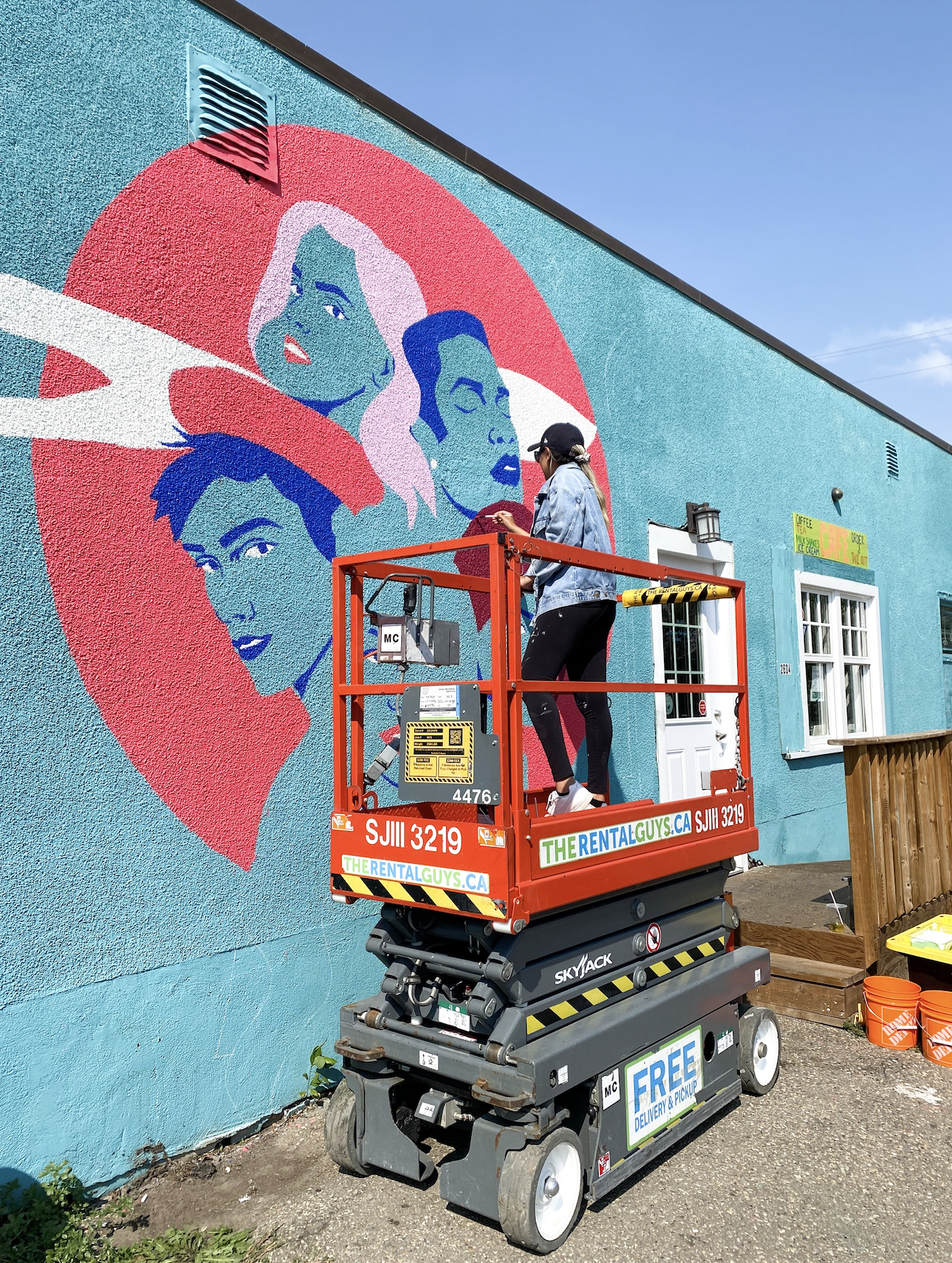
Calgary's built environment is undergoing a quiet but significant transformation. Where once there were blank concrete walls and utilitarian facades, there are now large-scale murals that redefine streetscapes, activate dormant corridors, and give commercial districts a sense of identity that no amount of conventional signage can achieve. Commissioning a mural in Calgary is no longer an eccentric proposition reserved for arts organisations. It has become a deliberate, strategic decision made by business owners, developers, and community groups who understand that art fundamentally changes how people experience a place.
Yet the process of commissioning a mural remains opaque to most. The distance between "we want a mural" and a completed wall of work involves layers of consultation, design development, regulatory navigation, and installation logistics that are rarely discussed in public. This guide is intended to bridge that gap. Having designed and executed murals and art installations across Calgary for commercial, institutional, and community clients, we have seen what makes a commissioning process succeed and, just as importantly, what causes it to stall.
Why Commission a Mural in Calgary
The case for murals in a commercial context extends well beyond decoration. A well-conceived mural can anchor a brand's physical presence in a way that is impossible to replicate digitally. It creates a landmark. It generates organic social media engagement as passers-by photograph and share the work. For retail and hospitality businesses, murals have been shown to increase foot traffic and dwell time, turning a forgettable facade into a destination.
Calgary's mural culture has matured considerably over the past decade. The BUMP (Beltline Urban Murals Project) Festival, which began in 2017, has commissioned over 450 artworks and established an expectation among Calgarians that public art is part of the urban fabric. This cultural momentum means that a new mural in Calgary does not appear in isolation. It enters a conversation. Businesses that commission murals are participating in a broader civic movement toward creative placemaking, and the public tends to respond with genuine appreciation.
For property owners, murals also serve a practical purpose. A painted wall is significantly less likely to attract graffiti vandalism than a blank one. The presence of a commissioned artwork signals care, attention, and investment in the built environment, which has a measurable effect on perceptions of safety and neighbourhood quality.
The Commissioning Process: From Brief to Brushstroke
Every mural commission begins with a conversation, and the quality of that conversation determines the quality of the final work. The first step is to articulate what you are looking for, not necessarily in visual terms, but in terms of intent. What do you want the mural to communicate? Who is the audience? What is the physical context of the wall? These questions matter far more than arriving with a Pinterest board, though reference imagery is always welcome.
Initial Consultation and Site Assessment
A responsible muralist or design studio will always begin with a site visit. The wall itself dictates much of what is possible. Substrate material (brick, concrete, stucco, metal cladding), sun exposure, proximity to pedestrian or vehicle traffic, access requirements for lifts or scaffolding, and the condition of existing paint or coatings all factor into the design approach. In Calgary, where exterior walls endure Chinook-driven temperature swings of 20 degrees Celsius in a single day, substrate condition is particularly important.
During this stage, the artist or studio will also assess whether the wall requires any preparation, such as power washing, patching, or the application of a primer coat. For older Calgary buildings, lead paint testing may be necessary before any surface preparation begins.
Design Development
Once the site has been assessed and the creative brief is established, the design phase begins. This typically involves the development of two to three concept directions, presented as scaled renderings overlaid on photographs of the actual wall. The goal is to show the client exactly how the finished work will read in context, at scale, from the vantage points that matter most.
Design development is iterative. Expect at least two rounds of revision to refine colour palette, composition, and any typographic or branding elements. A strong design studio will push back on ideas that will not translate well at scale or that will deteriorate poorly in Calgary's climate. This kind of honesty is not resistance; it is protection of the client's investment.
A mural is not a canvas painting enlarged. It is architecture. It must respond to the building, the street, and the city.
Calgary Mural Permits and Legal Considerations
One of the most common questions we hear is whether a mural in Calgary requires a permit. The answer, thankfully, is relatively straightforward. Under the City of Calgary's Land Use Bylaw 1P2007, murals are classified as "art signs," which fall within the Class A (basic sign) category. Art signs are defined as primarily artistic drawings applied or affixed to a building's exterior, with a maximum of 10 per cent of the sign area consisting of text. Because Class A signs do not require a development permit, most murals in Calgary can proceed without formal planning approval.
However, there are exceptions. If the mural incorporates more than 10 per cent text, it may be reclassified as a fascia sign (Class B), which does require a permit. Similarly, if the building is located within a heritage overlay or a specific design-controlled district, additional approvals may be needed. Murals on buildings adjacent to the Calgary Transit corridor or within certain Business Improvement Areas (BIAs) may also trigger review requirements.
Beyond municipal permits, commissioning a mural involves a series of legal protections that benefit both parties. A well-drafted contract should address the following:
- Scope of work including dimensions, location, colour palette, and approved design
- Timeline with milestones for design approval, wall preparation, and painting
- Intellectual property clarifying whether the client owns the design outright or whether the artist retains reproduction rights
- Moral rights under the Canadian Copyright Act, which grants artists the right to the integrity of their work even after sale
- Maintenance obligations specifying who is responsible for touch-ups, protective coatings, and graffiti removal
- Decommissioning terms outlining the process if the mural must be removed or the building demolished
In Canada, moral rights cannot be assigned but can be waived. This is a nuanced area of law, and we encourage all clients to seek independent legal advice when commissioning large-scale works. The conversation around moral rights is not adversarial. It is about establishing mutual respect for the work and the investment behind it.
Installation Timeline for Calgary Murals
Calgary's climate imposes a defined painting season for exterior murals. Most exterior latex and acrylic paints require ambient temperatures above 10 degrees Celsius for proper adhesion and curing, which effectively limits outdoor mural installation in Calgary to mid-May through mid-October, though warm Chinook windows can occasionally extend the season at either end.
A typical mural commission follows this approximate timeline from first conversation to completed wall:
- Initial consultation and site assessment: 1 to 2 weeks
- Design development and revisions: 3 to 6 weeks
- Wall preparation (cleaning, priming, repairs): 2 to 5 days
- Painting and installation: 1 to 4 weeks, depending on scale and complexity
- Protective coating application: 2 to 3 days after paint has fully cured
For a moderately sized exterior mural (roughly 500 to 1,500 square feet), the entire process from first meeting to final seal coat typically spans eight to fourteen weeks. Larger works, multi-wall installations, or projects requiring scaffolding or aerial lifts will naturally require more time. Interior murals can be executed year-round and generally move faster, as climate considerations are removed from the equation.
We advise Calgary clients to begin the commissioning conversation in late winter or early spring. By the time design is finalised and materials are sourced, the weather window opens, and installation can proceed without the pressure of a shrinking season.
Choosing the Right Muralist or Studio in Calgary
Calgary is home to a deep and diverse community of mural artists, from independent painters with roots in graffiti culture to multidisciplinary design studios that approach murals as integrated architectural elements. The right choice depends entirely on the nature of the project.
For brand-driven commercial murals where the artwork must align precisely with an existing visual identity, a design studio with experience in creative direction and spatial design will typically deliver a more controlled outcome. For community-facing murals where authenticity and local voice are paramount, an independent artist with strong ties to the neighbourhood or cultural community may be the better fit.
When evaluating potential collaborators, look for the following:
- A portfolio that demonstrates range in scale, substrate, and context
- Experience working in Calgary's climate specifically, not just outdoor murals in general
- Clear communication about process, timelines, and what to expect
- References from previous commercial clients, not just community or festival work
- An understanding of building science: primers, coatings, substrate preparation
At KINN Studios, our approach to mural commissions is grounded in architecture and creative direction. We treat every wall as a spatial problem first and a painting surface second. The design must respond to the building's geometry, the street's sightlines, and the way people actually move through the space. This architectural lens distinguishes a mural that endures from one that merely fills a wall.
After the Mural: Maintenance and Longevity
A mural is not a permanent fixture in the way that a building's structure is permanent, but with proper care, an exterior mural in Calgary can retain its vibrancy for seven to fifteen years. The single most important post-installation step is the application of a UV-resistant clear coat, which protects against colour fading and provides a barrier against moisture infiltration. Products such as MuralShield and MuralGuard are specifically formulated for this purpose and can extend a mural's lifespan significantly.
For a deeper understanding of how Calgary's specific climate conditions affect outdoor murals, including the impact of Chinook winds, hail, and UV exposure, see our companion article on mural longevity in Calgary's climate.
Ongoing maintenance should include an annual inspection of the painted surface, typically in spring after the freeze-thaw cycle has concluded. Look for hairline cracking, areas of delamination, or spots where moisture may be penetrating behind the paint film. Early intervention, a small touch-up or a fresh coat of sealant, prevents minor issues from becoming major restoration projects.
Interior murals, by contrast, require very little maintenance beyond occasional cleaning. In high-traffic commercial environments, a matte or satin clear coat will protect against scuffing and allow the surface to be wiped down without damaging the artwork.
Commissioning a mural in Calgary is an investment in the identity of a place. It is a declaration that a building is more than its function, that a business is more than its signage, and that the city itself is richer for having art woven into its everyday architecture. If you are considering a mural for your Calgary business, property, or community space, we would welcome the conversation. You can also explore our completed projects to see how we approach this work.